


Introduction
Concrete and masonry grinding shouldn’t feel like working inside a sandstorm. Yet on real jobsites, airborne dust can obscure your grind line, load up your cup wheel, and leave fine grit in every corner—plus it can shorten tool life when dust finds its way into bearings and switches. So what’s the practical fix when you want faster progress and a cleaner setup? Start with a grinding dust shroud that matches your disc size and grinder geometry.
This list focuses on HERZO grinding dust shrouds that are built around the same jobsite reality: if the shroud doesn’t fit, doesn’t seal, or blocks visibility, it won’t get used. In 2025, that matters more than ever as silica awareness and dust-control expectations continue to rise across renovation and surface-prep work.OSHA’s construction silica standard highlights controlling respirable crystalline silica exposures—often through control methods and plans that include dust controls like shrouds and effective vacuuming.
Below, you’ll find top HERZO options organized by common grinder and disc sizes—125mm (5”) and 180mm (7”)—plus a universal shroud for crews that rotate tools between jobs.
Top HERZO Grinding Dust Shrouds by Disc Size
For 125mm / 5” surface grinding setups
1. HERZO 125mm/5“ Clear Grinding Dust Shroud Kit with Diamond Turbo Cup Wheel

If you’re building a straightforward 5” surface-grinding setup, this kit is the “start grinding today” option—because it pairs a clear dust shroud with a 125mm diamond turbo cup wheel. That pairing matters on small-to-mid concrete leveling jobs where the fastest way to lose time is juggling mismatched parts or discovering clearance issues after installation.
-
Best for: Indoor concrete/stone surface grinding where visibility and dust control are both priorities.
-
Visibility advantage: The clear cover helps you track your grind path and edge transitions without constantly lifting the tool.
-
Dust capture approach: A brush-ring seal plus a front vacuum port is designed to capture dust at the source.
-
Included item: 125mm diamond turbo cup wheel (bundled) for material removal with reduced heat buildup.
-
Fitment range: Designed to fit many common 4-1/2” to 5” angle grinders.
-
Workflow tip: Pair it with a high-efficiency vacuum and keep the hose supported to reduce “hose drag” that can break your seal.
Why it wins: For many users, the real “performance upgrade” isn’t just the cup wheel—it’s consistent line-of-sight plus a sealed perimeter. When you can see the surface and keep negative pressure steady at the edge of the shroud, you tend to grind more evenly, pause less to check progress, and reduce the dust plume that forces cleanup and rework.
2. HERZO 125mm Aluminum Dust Shroud Kit with Diamond Turbo Cup Wheel (Variant Listing)

Sometimes the “best product” decision is the one that avoids downtime. This is a second listing for a very similar 125mm kit concept—shroud + turbo cup wheel—so it’s useful when one page is out-of-stock, region-restricted, or temporarily unavailable. If you’re a distributor or a crew lead ordering multiple sets, having a backup listing can help you keep your standard kit consistent across jobs.
-
Best for: Keeping a standardized 5” surface-grinding kit available for the team.
-
Core idea: Bundled shroud + cup wheel simplifies compatibility decisions.
-
Setup benefit: A kit approach reduces trial-and-error when you’re trying to get dust capture working on day one.
-
Visibility: Kit listings in this series commonly emphasize visibility and source capture (clear cover + extraction).
-
Jobsite practicality: Helps maintain repeatability—same general setup, same hose routing, same training.
-
What to confirm: Grinder collar/guard clearance and the shroud’s mounting method on your specific tool.
Why it wins: The most expensive delays on surface-prep work come from stoppages—waiting on replacements, swapping grinders, or trying to “make it work” with a poor-fitting shroud. A variant listing gives you a second path to the same style of solution so your workflow doesn’t depend on a single page’s inventory status.
3. HERZO HDE45X Clear Grinding Dust Shroud 125mm (4.5”/5”), Brush‑Ring Extraction
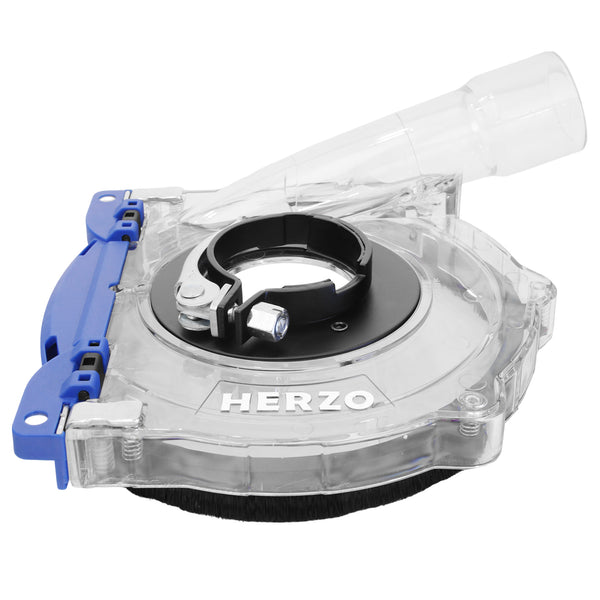
If you already have a preferred 125mm cup wheel—or you’re supplying wheels separately—this shroud-only option is a clean way to upgrade dust capture without buying another bundled consumable. The HDE45X is positioned for 125mm (5”) cup wheels and focuses on two fundamentals: visibility and sealing.
-
Best for: 125mm cup-wheel grinding when you want a clear housing but don’t need a bundled wheel.
-
Visibility advantage: Clear top improves line-of-sight for edge tracking and spotting surface high points.
-
Seal style: Brush-ring sealing is built to reduce perimeter leakage while still allowing the grinder to glide.
-
Extraction layout: Front vacuum port is designed to pull dust at the source rather than letting it billow outward.
-
Fitment target: Fits many common 4-1/2” to 5” grinders (guard/flange design affects compatibility).
-
Changeover speed: Quick-mount design supports faster job changes when moving room-to-room.
Why it wins: A shroud doesn’t just “catch dust”—it also influences how steadily you can grind. The brush ring can help maintain consistent contact across small dips and aggregate, which improves capture efficiency and helps you keep a more uniform finish because you’re not stopping to manage dust bursts.
For larger 180mm / 7” grinders
4. HERZO Aluminum Dust Shroud 180mm (7”) for Angle Grinders

If you’re running a 7” setup, you’re usually chasing coverage: larger contact patch, more surface area, and fewer passes. That’s exactly where dust management can fall apart—because higher material removal and longer continuous runs can overwhelm weak seals or flimsy housings. This 180mm aluminum shroud is designed for durability and stability in high-dust, high-load grinding.
-
Best for: Large-area concrete grinding (floor leveling, surface finishing) with a 7” grinder.
-
Housing material: Aluminum housing for stability under heavy-duty conditions.
-
Edge access: Flip-up nose design supports wall runs and edge grinding.
-
Seal and capture: Brush ring plus front extraction port for source dust control.
-
Fitment strategy: Includes multiple adapters to improve compatibility across grinder models.
-
Practical note: Cup wheel height and brush-ring travel vary; dialing in installation position can improve clearance and capture.
Why it wins: On bigger grinders, rigidity matters. A stable housing helps reduce micro-gaps that open when you transition over uneven slab or patch edges. That translates into more consistent capture and fewer dust “blowouts,” especially during long, continuous passes where you want to keep the grinder moving instead of stopping to clear the work area.
For mixed-size or multi-grinder crews
5. HERZO Universal Surface Grinding Dust Shroud, Red

If you’re supporting a multi-grinder environment—different brands, different operators, different disc sizes—the universal approach can reduce changeover time. This red universal shroud is designed for concrete, stone, and tile grinding, and it’s offered in multiple sizes (including 125mm and 180mm variants), which helps you stay consistent in features while matching the disc diameter.
-
Best for: Crews that need a transferable dust-control shroud across jobs and grinders.
-
Edge work: Detachable front nose enables flush, close-to-edge grinding along walls or posts.
-
Seal approach: Brush-ring seal supports source capture even when the surface isn’t perfectly flat.
-
Extraction layout: Front vacuum port to capture dust at the point of generation.
-
Adjustability: Adjustable height helps maximize cup wheel life and tune brush contact.
-
Included accessories: Adapter collars and a vacuum hose adapter are included for common tool necks and hose sizes.
Why it wins: Universal doesn’t have to mean “compromise,” as long as the shroud still seals and stays controllable. The detachable nose plus height adjustment is especially useful if you’re swapping between cup wheels with slightly different profiles—because small geometry changes can create either rubbing (too low) or leakage (too high). Being able to tune that quickly keeps dust control consistent.
Buying Guide: How to Choose the Right Shroud
Disc size and guard fitment—what must match?
Start with disc diameter, because it defines both coverage and clearance. If you run 125mm (5”) cups, a 125mm shroud keeps the brush ring closer to the dust source and tends to feel more nimble in tight rooms. If you run 180mm (7”) tools, you typically need the larger shroud to maintain proper coverage and avoid leaving the wheel exposed at the perimeter. Next, confirm the grinder’s guard/flange geometry. Even if two tools are both “5-inch grinders,” their collar shapes and guard mounts can differ enough to change how a shroud seats. That’s why adapter collars matter: they give you a way to dial in the interface so the shroud stays stable instead of wobbling during load.
Visibility—do you need a clear housing?
Ask yourself a jobsite question: “Am I grinding to a line, to a patch edge, or to a finish standard?” If the answer is yes, a clear shroud can save time because you can see the surface contact, track edges, and catch uneven pressure early. That’s most obvious when feathering transitions around repairs or leveling high spots without gouging. Clear housings also reduce stop-and-check habits. Instead of pausing every pass to confirm coverage, you can watch the grind path develop in real time.
Seal and airflow—why do brushes matter?
A shroud is only as good as its seal and airflow. The brush ring is the flexible interface that lets the shroud glide while still maintaining negative pressure at the edge. On smooth slabs it’s straightforward; on textured concrete, exposed aggregate, or slightly uneven repairs, the brush ring helps follow the contours so dust doesn’t jet out at gaps. Airflow is the other half. A front vacuum port positioned near the grind zone encourages dust to travel into the hose instead of swirling inside the shroud.
Material choice—aluminum vs composite housing?
Material choice is less about “better” and more about job conditions. Aluminum housings are commonly chosen when you expect heavier impacts, more continuous duty cycles, and the kind of vibration and heat that can flex lighter assemblies. If you run a 7” grinder for large-area coverage, stability can feel like a performance feature because it helps keep your seal consistent. Composite or clear housings prioritize visibility and lighter handling. For room-to-room renovation or finish-sensitive patch blending, the ability to see the work often matters more than maximum rigidity.
Practical tips (fast wins)
-
Dry-fit first: Before powering on, mount the shroud and rotate the cup wheel by hand to confirm internal clearance.
-
Keep the brush ring clean: Caked dust and slurry stiffen bristles, which can reduce sealing and increase drag.
-
Support the hose: Route the vacuum hose so it doesn’t pull sideways on the shroud during wall runs.
-
Use a high-efficiency vacuum setup: Better filtration and steady airflow typically improve visibility and reduce residual dust.
Common mistakes to avoid
-
Choosing by grinder label, not the wheel you actually use: Always match shroud size to real disc diameter first.
-
Running with a clogged filter: As filters load, airflow drops, and dust escapes faster than the vacuum can pull it in.
-
Leaving the shroud “too high”: If the brush ring doesn’t contact the surface evenly, you’ll see dust leaking at the perimeter.
-
Forcing edge work without an edge-friendly design: A detachable or flip-up nose makes a real difference at walls.
Comparison Table
|
Product |
Disc size |
Body type |
Visibility |
Brush ring |
Best use |
Included items |
|---|---|---|---|---|---|---|
|
HERZO 125mm/5“ Clear Kit |
125mm |
Clear housing (kit) |
Clear cover |
Yes |
Fast setup for indoor surface grinding and leveling |
Shroud + 125mm diamond turbo cup wheel |
|
HERZO 125mm Aluminum Kit |
125mm |
Kit listing |
Clear/visibility-focused |
Yes |
Backup listing for keeping a standardized 5” kit available |
Shroud + turbo cup wheel (listing-dependent) |
|
HERZO HDE45X Clear Shroud |
125mm |
Clear shroud |
Clear top |
Yes |
Shroud-only upgrade when you already have a preferred cup wheel |
Shroud only |
|
HERZO Aluminum Shroud 180mm |
180mm |
Aluminum housing |
Not clear |
Yes |
Large-area grinding, floor leveling, and heavy-duty runs |
Shroud + adapter/fastener kit + vacuum adapter + wrench |
|
HERZO Universal Red Shroud |
125/180mm variants |
Universal shroud |
Not clear |
Yes |
Multi-grinder crews; adjustable setup; close-to-edge grinding |
Shroud + adapter collars + vacuum hose adapter |
FAQs
Start by confirming the diameter of the cup wheel you actually run—125mm (5”) and 180mm (7”) are the most common in this lineup. Then check your grinder’s guard, flange, and collar geometry, because the shroud needs enough clearance to avoid rubbing while still sealing at the surface. If you switch between grinder sizes regularly, it’s usually more consistent to keep size-matched shrouds rather than forcing a large shroud onto a small setup. Finally, use adapter collars when provided to stabilize the mount and reduce wobble under load.
Clear housings help you keep the cup wheel exactly where it needs to be, which is especially useful when feathering patch edges or blending transitions. They also make it easier to notice wheel loading or glazing without stopping every few passes. Over a full room, that visibility can reduce rework because you catch uneven contact early. If your work is finish-sensitive, clear shrouds are often the more forgiving choice.
A brush ring helps the shroud seal to the surface while still allowing the tool to move, which improves source capture on slightly uneven concrete. It reduces dust leaks at the perimeter—especially on textured slabs, repair edges, or near joints where gaps form easily. If your vacuum is strong but dust still escapes around the shroud edge, the brush ring is often the missing piece. Keep bristles clean and un-matted, because packed dust increases drag and can reduce effective sealing.
Yes—many surface grinding setups pair a dust shroud with a diamond cup wheel for controlled material removal and better visibility. The key is ensuring internal clearance so the cup wheel never contacts the shroud during rotation, even if you tilt slightly in use. A bundled kit can reduce selection errors because the shroud and wheel are intended to work together as a set. Still, it’s smart to dry-fit, hand-spin the wheel, and verify mounting stability before you start grinding.
First check airflow: clogged filters, full dust bags, kinked hoses, or loose adapters can cut suction more than people expect. Next, inspect sealing—if the shroud sits too high, dust will escape at the perimeter faster than the vacuum can pull it in. Brush-ring condition matters too; stiff or worn bristles create gaps and reduce capture consistency on rough surfaces. Finally, consider hose management: if the hose drags or pulls sideways, it can open micro-gaps and reduce source capture.
Aluminum housings are typically chosen for durability and stability during heavier-duty, longer-run grinding—especially on larger grinders where vibration and heat build faster. The added rigidity can help maintain a more consistent seal when you transition across uneven slabs, which improves capture and reduces dust bursts. However, visibility can matter more than housing rigidity for finish-sensitive work, which is where clear shrouds shine. Choose based on your grinder size, how often you grind indoors, and whether edge tracking or maximum durability is the priority.
Conclusion
Choosing the right grinding dust shroud is mostly about matching reality: the disc diameter you run, the grinder geometry you own, and how clean you need the workspace to stay while you grind. Start by matching size (125mm vs 180mm), then decide whether visibility (clear housings) or heavy-duty stability (aluminum) matters most for the work you do. From there, prioritize sealing and airflow—brush rings and a properly connected vacuum are what turn a shroud from “plastic accessory” into a real productivity tool.
If you want a simple path to cleaner 5” grinding, the HERZO 125mm clear kit is a practical entry point. If you’re running a 7” setup for larger coverage, the HERZO 180mm aluminum shroud brings durability and edge-friendly features into the workflow. And if you’re managing multiple grinders across a crew, the universal red shroud can help reduce changeover time while keeping dust capture consistent.


