


Introduction
Matching a dust shroud to a vacuum hose sounds simple until you’re on a jobsite and the cuff won’t seat, suction feels weak, or the hose keeps popping off mid-pass. In practice, “dust shroud compatibility” is a system problem: the shroud’s capture zone and seal need steady negative pressure, and that depends on hose diameter, cuff geometry, airflow losses, and how cleanly you can adapt one interface to another.
This ultimate guide is written to help a distributor, a professional craftsperson, or a DIY enthusiast standardize dust collection setups fast—without guesswork, duct tape, or choking down airflow. You’ll learn how to identify your hose connection type, choose an adapter strategy that preserves suction, and confirm grinder fitment so the shroud doesn’t rub the wheel or bind.
Dust Shroud and Vacuum Hose Matching Fundamentals
Dust shrouds: the capture zone and the seal
A grinding dust shroud has two jobs that must happen at the same time. First, it creates a capture zone around the wheel where dust is generated. Second, it maintains a seal—usually a brush ring or skirt—that limits outside air intrusion so the vacuum can concentrate suction at the wheel. If either part fails, you’ll see the symptoms immediately: dust trails at edges, haze in small rooms, and debris that accumulates faster than you can grind.
What most users miss is that the shroud is not “a vacuum attachment,” it’s an airflow component. A good shroud design keeps the extraction path short and stable, while the brush ring stays in consistent contact even as you change pressure or move across micro-highs in concrete. That’s why rigid bodies (often aluminum) tend to feel more predictable under load, while transparent covers can improve precision in tight indoor work where visibility affects quality.
Vacuum hoses: diameter, cuff geometry, and flexibility
Vacuum hoses are defined less by the hose itself and more by the ends. You’ll typically interface through a cuff (sometimes called a tool-end), which can be friction-fit, twist-lock, bayonet, or threaded. The important measurements are the hose inside diameter (ID), the cuff outside diameter (OD), and the port size on the shroud. When these don’t match, users often “solve” it by forcing a loose fit—creating leaks—or by reducing too aggressively—creating airflow restriction.
Flexibility matters too. Highly corrugated hoses bend easily, but the internal turbulence and added friction can increase pressure loss. Smoother interior hoses generally preserve airflow better, and shorter hose runs typically improve dust capture for grinding, especially when you’re trying to keep fine dust from escaping around edges.
Airflow basics: CFM, static pressure, and real-world losses
Dust extraction performance is usually described with airflow (CFM) and static pressure (often measured as water lift). Grinding produces fine particles that behave differently than chips; they stay airborne longer and escape through tiny gaps. That makes the system sensitive to restrictions. Every sharp reducer, long hose run, and tight bend acts like a tax on airflow.
NIOSH has shown that local exhaust ventilation shrouds paired with appropriate vacuums can dramatically reduce exposures during concrete grinding, and it highlights practical system details like using a relatively smooth hose and limiting length for adequate airflow.
Identify Your Hose Connection Type
Before you buy adapters—or blame the shroud—identify exactly what you’re connecting. This is the single most important step for avoiding wobble, leaks, and disconnections.
What to measure (and how)
Start with three measurements:
-
Vacuum cuff OD (outside diameter of the part that will insert into the shroud port).
-
Hose ID (inside diameter of the hose at the tool end).
-
Shroud port ID/OD depending on whether the port accepts an insert (male into female) or a sleeve (female over male).
Use calipers if you have them; otherwise, a decent tape plus careful reading is workable. Measure in millimeters when possible because most tool ports and adapters cluster around common metric steps.
Recognize the connection style
Look for these cues:
-
Tapered friction-fit: Smooth or lightly ribbed cuff that relies on compression. These work well when sizes are close, but they’re prone to loosening when the hose twists during edge work.
-
Twist-lock/bayonet: Locking tabs or lugs. Great for retention, but adapters must match the geometry, not just the diameter.
-
Threaded cuffs: Less common on jobsite vacs, more common on some extractors and specialty systems. Thread pitch and diameter both matter.
If your cuff is tapered, note whether it narrows toward the tip. A tapered cuff can “feel” like it fits but may only contact at a small ring, creating micro-leaks under load.
Match Port Diameter and Adapter Strategy
Once you know your connection type, you can choose an adapter approach that preserves airflow and keeps the system stable.
Choose a “primary path” diameter (32–38 mm logic)
Most tool-end dust extraction systems cluster around a few practical sizes, often roughly 32 mm, 35 mm, and 38 mm equivalents. Your goal is to pick the largest practical diameter that still seals cleanly and is manageable on an angle grinder.
-
If your vacuum and hose are strong and you’re doing heavy grinding, staying larger reduces restriction.
-
If you’re doing delicate edge work in tight spaces, a slightly smaller hose can improve maneuverability, but you must avoid excessive reductions.
For a distributor stocking accessories, this suggests a strategy: pick a core adapter set that converts common vac cuffs to the shroud port size without forcing customers into multi-step “adapter stacks.”
Use stepped reducers or sleeves (and know the trade-offs)
Stepped reducers are useful when you’re moving between tool ecosystems. However, they introduce two risks:
-
Turbulence at sharp transitions, which reduces effective airflow.
-
Leak points at each junction.
A sleeve (single transition) is usually better than chaining reducers. If you must chain, keep the number of steps minimal and ensure each joint has a positive stop or tight compression.
Product recommendation: HERZO Universal Surface Grinding Dust Shroud, Red
HERZO’s universal red grinding shroud is designed for job-to-job flexibility across crews that run different wheel diameters. It’s offered in 125 mm (5”), 180 mm (7”), and 230 mm (9”) sizes, with a detachable nose for flush grinding near walls or posts, and adjustable height to tune brush contact as cup wheel diameter and wear change. The combination of a brush-ring seal and a front dust port is exactly what you want when the main goal is consistent capture without sacrificing maneuverability.

Optimize Airflow for Grinding Dust
Grinding dust is unforgiving because it’s fine, persistent, and easily pulled into the air stream around doors, vents, and foot traffic. To control it, you need both good shroud sealing and a hose/vacuum setup that sustains airflow.
Balance hose diameter and vacuum capability
A common mistake is assuming “smaller hose equals stronger suction.” In reality, a smaller hose can increase air velocity but often reduces total airflow, especially if the vacuum is already working near its limits. For concrete grinding, you typically want enough airflow to keep the capture zone under negative pressure even when the brush ring is partially lifted by uneven surfaces.
If your dust capture is weak at the edges, don’t immediately blame the shroud. First check whether your hose and adapters are creating a bottleneck—especially if you’ve reduced in multiple steps.
Favor shorter hoses and smoother routing
A practical rule: treat every extra foot of hose as a small performance penalty. Keep hose length as short as workable for the space, and avoid routing that creates tight bends near the shroud port. For indoor rooms, this also reduces trip hazards and helps keep the grinder motion smooth.
Product recommendation: HERZO 125mm Aluminum Dust Shroud Kit + 115mm Double-Row & 125mm Turbo Cup
If you want a ready-to-work setup for 4-1/2”–5” grinders, HERZO’s 125 mm aluminum kit is built around dust-controlled grinding on concrete and stone. It combines a flip-up edge nose (useful for close-to-wall passes), a brush-ring seal, and a front vacuum port for source extraction. The kit description also highlights height adjustment to match different cup wheels and a quick-mount clamp for faster setup.
What’s especially useful for workflow is that this kit includes two wheels: the HERZO HSO4.1T Segmented Double-Row Diamond Cup 115 mm (Blue) plus a 125 mm diamond turbo cup. In practice, that gives you flexibility to switch between more compact access and broader coverage without rebuilding your dust control approach.

Fitment for Angle Grinder Shrouds
Even perfect hose matching won’t help if the shroud doesn’t mount correctly to the grinder. Fitment problems show up as rubbing, binding, overheating, and poor dust capture because the brush ring can’t sit evenly.
Confirm grinder guard collar and mounting style
Angle grinders vary widely in guard collar dimensions and how accessories mount. Before committing to a shroud:
-
Confirm whether the shroud uses a clamp-style mount, quick-mount interface, or adapter collars.
-
Check whether the grinder’s guard and flange design leaves enough room for the shroud body.
-
Confirm that your cup wheel (or blade) is compatible with the shroud’s intended diameter.
Product recommendation: HERZO Aluminum Dust Shroud 180mm (7”) for Angle Grinders
For larger floor areas and faster coverage, HERZO’s 180 mm (7”) aluminum shroud is built to stay stable under load. It’s identified as Model HED60V and uses an aluminum housing for durability during extended grinding. The design includes a flip-up nose for wall and edge runs, plus a brush ring and front extraction port for source dust control. It also includes multiple adapters and a standard vacuum adapter to help interface across different grinder collars.

Seal Control: Brushes, Skirts, and Windows
Seal control is where dust collection becomes “feel.” Even with strong vacuum power, the shroud must manage edge gaps, uneven concrete, and directional changes.
Select brush ring stiffness and height for the surface
Brush rings come down to two competing needs: compliance and sealing.
-
Softer/longer brushes conform better to uneven surfaces and help with edge capture, but they can drag more and reduce visibility.
-
Stiffer/shorter brushes glide more cleanly and can feel more controllable, but they may leak more at joints, expansion lines, or rough patches.
If you’re consistently seeing dust plumes at the back of the shroud, it’s often because the brush ring is too worn or too short to maintain contact when you change pressure.
Use a clear shroud for sightlines and precision
Transparent covers aren’t just for looks. In tight indoor work, being able to see the contact patch reduces over-grinding and helps you feather transitions cleanly. This matters when you’re grinding near cabinets, thresholds, drains, or where you’re trying to keep the surface flat without chasing low spots.
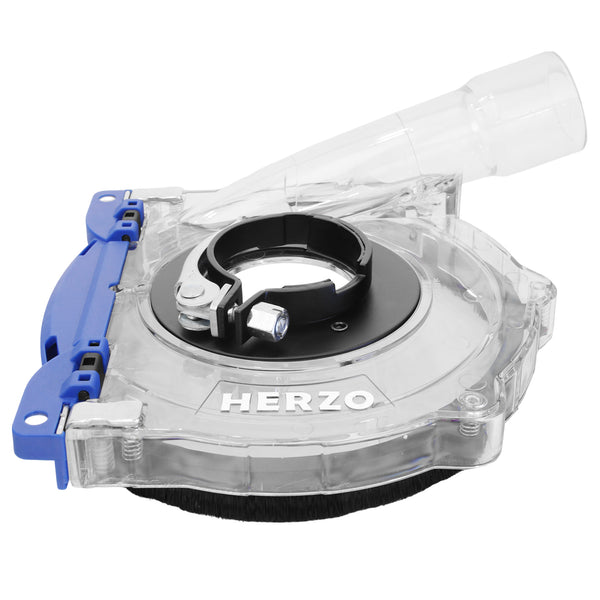
Product recommendation: HERZO HDE45X Clear Grinding Dust Shroud 125mm
HERZO’s HDE45X is built around visibility and quick setup for 4-1/2”–5” grinders. It uses a clear cover for line-of-sight, a brush-ring seal, and a front vacuum port to capture dust at the source. It’s intended for 125 mm (5”) cup wheels and features a quick-mount design, which is useful when you’re moving between rooms or switching grinders frequently.
How to Choose the Best Dust Shroud and Hose Match
Hose diameter: match the port without unnecessary adapters
Start by aiming for a direct match between the hose cuff and the shroud port. Every extra step is a potential leak and restriction. If you must adapt, choose a single reducer or sleeve that preserves the largest practical diameter.
Cuff style: friction-fit vs twist-lock vs threaded
Retention is the difference between a smooth workflow and constant interruptions. Friction-fit is fast but can loosen; Twist-lock improves security but needs compatible geometry; Threaded is secure but slow. Pick the style that matches your work pace.
Material and durability: aluminum vs composite bodies
Aluminum housings often hold shape better under heavy pressure and heat, helping keep brush contact consistent. Composite or clear bodies can improve visibility and reduce weight for precision work. Many crews end up with both for different job phases.
Decision framework table
|
Application scenario |
Primary risk |
Best matching priority |
Recommended approach |
Trade-offs |
|---|---|---|---|---|
|
Small indoor room (bath, laundry) |
Airborne haze + over-grinding edges |
Seal + visibility |
Use a clear shroud, short hose run, tight cuff fit |
Slightly less rugged for heavy production load |
|
Large slab leveling |
Seal gaps on uneven surface |
Stability + airflow |
Larger shroud size, rigid body, minimize reducers |
Heavier tool feel, less nimble near obstacles |
|
Mixed grinder fleet (multiple brands) |
Fitment failures and downtime |
Adapter strategy + universality |
Universal shroud with included collars; document collar sizes |
Universal fit can require tuning |
|
Edge runs along walls |
Leaks at open nose |
Retention + technique |
Flip-up/detachable nose; secure hose connection |
More sensitive to airflow loss |
FAQs
Most tool-end dust collection setups land in the 32–38 mm range, but “fits” depends on the cuff and port geometry, not just a number. Measure your vacuum cuff OD and the shroud port size before buying adapters, especially if your cuff is tapered. If you’re a distributor supporting multiple vacuum brands, standardize on a few adapter sizes and document the exact measurements they cover.
Yes—sharp reductions and multiple adapter steps increase losses, which can reduce the negative pressure at the shroud’s capture zone. The practical impact is more dust escaping at edges and more haze indoors, even if the vacuum is running at full power. Use the largest practical hose diameter you can control comfortably on the grinder.
First, confirm you’re not relying on a shallow taper fit—full-depth insertion and correct diameter matter more than force. Second, route the hose so it doesn’t pull sideways when you pivot the grinder; that torque is a common cause of pop-offs. If your cuff is friction-fit, a proper clamp can help, but only if it doesn’t deform the cuff.
This usually indicates restriction or leakage between the vacuum and the shroud. Long hoses, tight bends, corrugated interiors, and multi-step reducers can all reduce effective airflow at the tool end. Leaks at the cuff or adapter joints also steal negative pressure from the capture zone.
With the tool unplugged, hand-spin the wheel and listen/feel for contact, then run the grinder briefly at idle before touching the surface. If you hear scraping, feel vibration that wasn’t there before, or see uneven wear marks inside the shroud, stop immediately and re-check mounting and clearance.
Conclusion
The best dust control results come from matching the dust shroud and hose as a single airflow-and-fitment system: measure cuff and port geometry, choose the largest practical diameter with minimal adapter steps, and protect sealing performance with proper routing and brush-ring maintenance. For a distributor, this means fewer returns and clearer compatibility guidance; for a professional craftsperson, it means faster setup and steadier performance; for a DIY enthusiast, it means cleaner indoor work and less rework.
If you want to build a reliable dust-free grinding setup, HERZO’s lineup gives you practical options for different scenarios—125 mm kits for ready-to-work indoor grinding, 180 mm aluminum shrouds for coverage and stability, universal red shrouds for mixed fleets, and clear HDE45X shrouds for precision and visibility.


