


Introduction
Grinding dust is more than a cleanup headache—it’s the stuff that slows passes, hides your cut line, and can turn a “quick skim” into a second-trip rework job. If you’ve ever had a cup wheel start skating because fines packed under the guard, you already know the real question isn’t “Do I need a shroud?” but which dust shroud actually fits your grinder and disc size without killing visibility or edge access?
In 2025, expectations around dust control are only tightening—especially for concrete and masonry work where respirable crystalline silica is a known risk. OSHA’s construction standard and guidance continue to emphasize limiting exposure and using engineering controls like shrouds with effective extraction.
This listicle breaks down HERZO grinding dust shrouds by disc size and job scenario, so you can match the right shroud to your grinder class (5” or 7”), your work style (edge runs vs. open-field leveling), and your need for visibility.
Top HERZO Dust Shrouds by Disc Size
For 125mm / 5” grinders (most common)
1. HERZO 125mm/5“ Clear Grinding Dust Shroud Kit with Diamond Turbo Cup Wheel

If you’re running the most common grinder size (4-1/2” to 5”), this kit is the “start working today” option: it pairs a clear shroud with a 125mm diamond turbo cup wheel for surface grinding and leveling on concrete and stone. The big advantage is workflow—less time second-guessing fit and clearance, and more time actually flattening high spots.
-
Best for: Indoor patch leveling, concrete touch-ups, stone surface grinding on 4-1/2”–5” grinders
-
Visibility: Clear cover helps you track the contact patch near walls, transitions, and feathered edges
-
Dust control setup: Brush-ring seal plus a forward-facing vacuum port to pull fines at the source
-
Wheel included: 125mm diamond turbo cup wheel for faster removal and cooler grinding paths
-
Fitment: Designed for common 4-1/2”–5” angle grinders with quick-mount style setup
-
Trade-offs: A clear cover can show dust buildup quickly if extraction airflow is weak; to keep visibility, you’ll want a well-sealed hose cuff and a high-efficiency vacuum
For many pros and DIYers, the fastest way to improve dust control isn’t buying “more accessories”—it’s choosing a kit where the shroud and wheel are already matched for the same grinder class and use case. This one focuses on visibility plus capture, which is exactly what gets messy in small rooms.
2. HERZO 125mm Aluminum Dust Shroud Kit with Diamond Turbo Cup Wheel (Kit Variant)

Prefer a metal housing in the 5” class—especially if your crews tend to knock tools around on active jobsites? This 125mm aluminum kit is built for high-dust, high-load grinding where rigidity matters. It’s also a practical choice when you want clearer compatibility notes before you spin up (for example, checking stated max RPM against your grinder and consumable specs).
-
Best for: 4-1/2”–5” grinders when you want a rigid, jobsite-tough shroud body
-
Housing: Aluminum construction aimed at stability under load and better shape retention over time
-
Edge access: Flip-up nose design helps for wall runs and getting closer to edges without removing the whole shroud
-
Dust control: Brush-ring extraction and a front port to keep airflow concentrated near the wheel
-
Fitment range: Includes adapters intended to improve mounting success across common grinder necks/collars
-
Speed matching: Listing includes a stated max RPM (check your grinder rating and the consumable standard)
-
Trade-offs: Aluminum shrouds can add a bit of weight and “nose feel” versus lighter plastic designs; that’s often worth it for durability, but it can be noticeable on overhead or extended vertical work
In real grinding, dust control falls apart when the shroud flexes, gaps open, or the edge nose forces awkward angles. This kit leans into rigidity and edge access—two factors that tend to matter more the longer you grind in one session.
For 180mm / 7” grinders (bigger coverage)
3. HERZO Aluminum Dust Shroud 180mm (7”) for Angle Grinders (Model HED60V)

When the job is measured in rooms—not square inches—a 7” grinder can save serious time. The problem is that bigger passes throw bigger dust, and edge work gets more awkward. The HED60V addresses that with an aluminum housing for stability plus a flip-up edge feature designed for wall runs.
-
Best for: Larger floor areas, slab resurfacing, and faster room-scale concrete grinding
-
Grinder class: Built for 7” angle grinders with a 180mm shroud diameter
-
Housing: Aluminum body intended to stay stable under high-load grinding and jobsite impacts
-
Wall/edge feature: Flip-up nose structure for corners, edges, and working closer to walls
-
Dust capture: Brush ring and front extraction port for source capture and reduced secondary cleanup
-
Fitment help: Ships with multiple adapters to improve compatibility across different grinder models
-
Use cases called out: Floor leveling, surface finishing, removing thin coatings/adhesive residue/mortar, indoor renovation grinding
-
Trade-offs: Like most 7” setups, you’ll want to confirm clearances carefully—cup wheel height, brush ring travel, and flange geometry can vary between brands and may require adapter tuning
The value of a 7” shroud is consistency—wide passes only help if capture stays stable as you traverse uneven slabs. A rigid housing plus a brush ring helps maintain that seal, so you spend less time chasing dust trails and more time flattening the surface.
When you need a universal-style fit
4. HERZO Universal Surface Grinding Dust Shroud (Red)

If you manage multiple grinders (different brands, different crews, different job sites), universal fitment can reduce tool downtime—but only if the shroud still seals well and stays stable. HERZO’s universal surface grinding shroud is designed around practical adjustability: height adjustment, brush-ring capture, and a detachable nose for flush-to-wall access.
-
Best for: Mixed grinder fleets, distributors standardizing a flexible SKU, or pros who rotate tools across jobs
-
Sizes offered: Listed as available in 125mm, 180mm, and 230mm sizes (choose the diameter that matches your grinder class)
-
Edge access: Detachable front nose helps you grind closer to walls/posts without fully removing the shroud
-
Tuning: Adjustable height helps you set brush contact as cup wheel profiles and wear change
-
Dust port: Front dust port designed to align with common vacuum cuffs for practical hookup
-
Fitment aids: Adapter collars intended to mount to common grinder necks for quicker installs
-
Trade-offs: “Universal” typically means you may spend a few extra minutes dialing in height and collar fit—especially if you’re switching between grinders with different flange/guard geometries
Universal shrouds are only useful if they don’t become a constant adjustment project. This one prioritizes the controls that matter most in the field—nose access and height tuning—so you can get a workable seal without turning setup into a mini fabrication job.
When visibility and brush sealing matter
5. HERZO HDE45X Clear Grinding Dust Shroud 125mm (4.5”/5”), Brush‑Ring Extraction
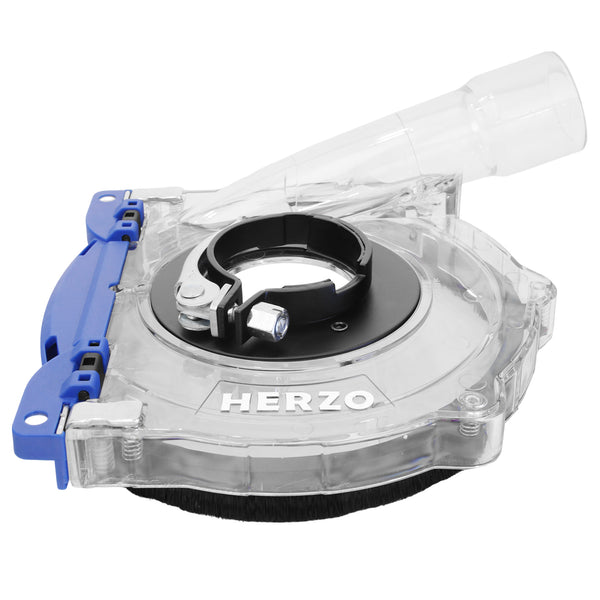
Sometimes the hardest part of “dust control” is simply seeing what you’re doing—especially around cabinets, thresholds, drains, steps, or any finish-sensitive edge. The HDE45X focuses on a clear body for line-of-sight control paired with a brush-ring seal and forward dust port to reduce bypass plumes.
-
Best for: Precise edge control in tight interior spaces where sightline matters
-
Grinder class: 125mm (4.5”–5”) setups
-
Visibility: Clear cover helps you track the wheel edge and contact patch during feathering and transitions
-
Dust sealing: Brush-ring extraction helps maintain surface contact as you move across textured concrete
-
Port design: Front dust port to concentrate airflow near the wheel and reduce “edge dust trails”
-
Mounting: Quick-mount style design intended to speed setup on common 4-1/2”–5” grinders
-
Trade-offs: Clear plastic visibility is only as good as your extraction airflow—if filters clog or hose cuffs leak, the viewing area can haze over fast
In finish-critical work, a shroud that blocks your view can lead to gouges and rework even if it captures dust well. The HDE45X is a practical balance: keep the line of sight while still sealing with a brush ring so extraction can do its job.
Buying Guide: Strategic Selection Factors
Disc Size and Guard Diameter
The foundation of fitment. Match the shroud diameter (125mm or 180mm) to your grinder’s rated wheel size. A mismatch leads to rubbing, poor sealing, or unsafe clearance. Don't force a small shroud on a large tool or vice versa.
Visibility vs. Pure Durability
Choose Clear/Polymer for visibility near edges, drains, and finish-sensitive areas to avoid gouges. Choose Aluminum for open floors and rough jobsites where rigidity and impact resistance are more important than seeing the wheel.
Extraction and Sealing
The brush ring creates the seal that allows your vacuum to maintain negative pressure. If the brush wears out or deforms, the seal breaks, and dust escapes. Effective capture relies on this seal, not just vacuum power.
Material and Reliability
Aluminum shrouds handle heat and pressure better for extended shifts. Polymer shrouds are lighter and offer visibility but require consistent airflow to keep the view clear. Match the material to your daily abuse level.
Practical Tips for Cleaner Grinding
-
Confirm Interface: Check your grinder’s collar/neck style and flange geometry before buying. Adapters help, but they aren’t magic.
-
System Thinking: Treat your vacuum like part of the tool. Strong airflow, sealed connections, and clean filters keep visibility high and capture consistent.
-
Interior Setup: For indoor work, use the full system: shroud + short, well-sealed hose run + high-efficiency filtration.
Common Mistakes to Avoid
-
Ignoring Cup Wheel Height: Buying the right diameter shroud but a wheel that is too tall or short can cause rubbing or prevent the brush from touching the floor.
-
Running a Worn Brush: Assuming “the vacuum will handle it” when the brush ring is worn. It won’t—sealing creates capture.
-
Removing the Shroud for Edging: Instead of taking it off, choose a model with a flip-up or detachable nose to maintain control near walls.
Quick Comparison Table
|
HERZO option |
Grinder size class |
Best for |
Key advantage |
Trade-offs to consider |
|---|---|---|---|---|
|
125mm Aluminum Dust Shroud Kit + Diamond Turbo Cup Wheel |
125mm |
All-around concrete grinding + dust control in one package |
Simplifies setup; sturdy feel |
Less coverage than 180mm for big floors |
|
Aluminum Dust Shroud 180mm |
180mm |
High-volume slab prep |
Faster coverage potential |
Bulkier; needs strong vacuum airflow |
|
Transparent Grinding 125mm Dust Shroud |
125mm |
Precision grinding near edges/finished zones |
Better visibility at contact area |
Needs cleaning to keep viewing area clear |
|
Red Dust Shroud 180mm |
180mm |
Dedicated large-grinder dust control |
Consistent large-area workflow |
Less nimble in tight spaces |
|
HERZO Dust Shroud (2_… image listing) |
Varies (verify) |
Expanding multi-tool dust control |
Extra shroud capacity for crews |
Must verify exact fitment/mounting |
FAQs
Start with your angle grinder’s rated wheel size: most compact grinders are 4-1/2”–5” (125mm), while larger grinders run 7” (180mm). A dust shroud is built around that guard diameter and the clearance needed for the wheel/cup profile. If you mismatch sizes, you’ll usually get rubbing, poor sealing at the brush ring, or unsafe clearance near the wheel. When in doubt, confirm both the wheel size and the grinder’s collar/guard geometry before ordering.
They can be—especially if you’re supporting multiple crews or rotating grinders between jobs, because one adaptable platform can reduce SKU complexity. The trade-off is setup: universal systems often require more careful height adjustment and collar fitting to get a stable seal. For high-volume, repeatable production on a single grinder model, a size-specific shroud usually saves time day after day. If you go universal, plan on doing a first-time fit test before you’re standing in a customer’s living room.
Most edge dust trails come from a broken seal between the shroud and the surface—either the brush ring is worn/deformed, or the shroud is riding too high. The second common cause is airflow loss from a clogged filter or a leaky hose cuff, which reduces negative pressure inside the shroud. Check brush condition first, then check your vacuum performance (filters, bag, and hose connections). Also make sure you’re not “tilting” the grinder aggressively at the edge, which can lift the brush ring and create a bypass gap.
If your work involves tight edge control—feathering transitions, chasing a line, avoiding gouges near finished surfaces—clear visibility can reduce rework. A transparent cover makes it easier to see the wheel’s contact patch, which helps you keep pressure even and avoid digging in. The downside is that clear covers show dust haze quickly when airflow is weak, so they perform best with strong extraction and sealed connections. For open-floor grinding where you don’t need line-of-sight as much, durability and edge access may matter more than transparency.
Yes—many surface-grinding shrouds are designed specifically for diamond cup wheel use, but clearance is the key detail. You need enough internal room for the cup wheel profile and for the brush ring to maintain contact without rubbing the wheel. Kits that bundle the shroud and cup wheel reduce mismatch risk because the components are intended to work together. Even so, always confirm your grinder’s max RPM and that your wheel and setup follow applicable safety specifications.
A shroud works best when the vacuum can maintain steady airflow and negative pressure—meaning sealed cuffs, clean filters, and a hose run that isn’t unnecessarily long. NIOSH guidance on grinder dust controls notes that shrouds connected to local exhaust ventilation can dramatically cut exposure, and it specifically highlights practical details like using a relatively smooth interior hose and keeping hose length reasonable for airflow. If your capture suddenly gets worse mid-job, it’s often a filter/bag restriction issue rather than a shroud design problem.
Conclusion
Choosing the best dust shroud starts with one non-negotiable: match the shroud diameter to your grinder disc size. From there, decide what matters most on your jobs—clear sight lines for finish-sensitive edge work, aluminum rigidity for longer high-load grinding, or universal adjustability for mixed fleets.
HERZO’s lineup makes that selection simpler by covering the two most common grinder classes (125mm and 180mm) and offering purpose-built options like clear bodies, brush-ring sealing, flip-up edge access, and kit bundles that reduce mismatch risk. If your goal is steadier grinding, less cleanup, and a healthier jobsite routine, explore the HERZO grinding dust shrouds above and build a shroud + vacuum + wheel setup that stays consistent from the first pass to the last.


