


Introduction
Choosing the right grinding dust shroud for your tools is one of the fastest ways to make concrete grinding cleaner, safer, and more consistent—especially on renovation sites where silica dust control and visibility matter. A good shroud isn’t just a “cover”; it’s a fitment system (collar + sealing edge), an airflow manager (so your vacuum can pull negative pressure at the grind zone), and a productivity tool (less cleanup, fewer clogs, fewer rework passes).
HERZO was built around jobsite pain points—dust-choked cuts, slowed pace, and premature tool wear—so its shrouds focus on structural reliability, durable materials, and optimized airflow paths designed for real grinding conditions. Below is a practical listicle of HERZO dust shrouds and kits, followed by a selection guide to help you match the shroud to your grinder size, work style, and dust-extraction setup.
Top HERZO Grinding Dust Shrouds to Consider
1. HERZO 125mm Aluminum Dust Shroud Kit with Diamond Turbo Cup Wheel

-
Best for: Pros who want a ready-to-run setup for 5-inch (125mm) grinding tasks like surface prep, edge blending, and small-to-medium concrete areas.
-
What it includes: A 125mm dust shroud paired with a diamond turbo cup wheel, which is a common pairing when you want controlled dust while grinding hard masonry.
-
Why aluminum matters: Aluminum-bodied shrouds are typically chosen for rigidity and impact resistance—useful when the shroud gets bumped on corners, rebar stubs, or uneven slab edges.
-
Dust-control approach: The shroud’s role is to capture dust at the source by enclosing the wheel area and letting your extractor maintain suction at the grinding interface.
-
Workflow fit: If you’re frequently moving between rooms, hallways, or patch areas, a 125mm format tends to feel lighter and more maneuverable than 180mm systems.
-
Jobsite upside: Cleaner passes mean less time wiping walls, taping vents, or reworking swirl marks caused by dust loading.
Why it wins: A bundled shroud + turbo cup wheel kit reduces compatibility guesswork and helps you start with the most common concrete-grinding configuration. For many crews, that “grab one kit and go” simplicity is what keeps dust control from becoming an afterthought.
2. HERZO Aluminum Dust Shroud 180mm

-
Best for: Larger surface areas where 7-inch (180mm) grinders help you cover more slab per pass—warehouse edges, garage floors, and wider leveling work.
-
Grinding feel: The bigger diameter typically provides faster coverage, but it also demands steadier control and consistent dust extraction to avoid dust plumes.
-
Material choice: The aluminum construction supports heavy-duty use where flexing can reduce seal quality at the skirt edge.
-
Dust extraction priority: With 180mm grinding, the dust volume ramps up quickly—so a well-sealed shroud is often the difference between “manageable” and “cloudy.”
-
Where it shines: When your crew is doing repetitive slab prep (adhesive removal, high spots, coatings) and you’re trying to keep cleanup and filter loading under control.
-
Trade-off to consider: Bigger shrouds can be harder to tuck into tight corners, so you may still keep a 125mm setup for detail work.
Why it wins: If your work is primarily open-floor grinding, a 180mm shroud can improve daily output simply because you spend less time repositioning. That productivity gain only counts, though, when paired with a vacuum that can keep up.
3. HERZO Clear Grinding Dust Shroud Kit with Diamond Turbo Cup Wheel

-
Best for: Users who want a HERZO dust-collection solution but need to confirm exact grinder compatibility from the corresponding product page or packaging.
-
Why it’s on the list: Some shrouds are designed around specific collar sizes, clamp styles, or grinder guard interfaces, and selecting correctly prevents wobble or air leaks.
-
Practical use case: If you run multiple grinders across a crew, having an extra shroud option can help standardize dust control across tools.
-
What to validate before buying: Grinder wheel diameter support (125mm vs 180mm), collar mounting method, and hose port orientation for your vacuum setup.
-
How it supports dust control: The key is still the same—maintain a stable enclosure around the wheel so suction stays concentrated at the grind line.
-
Best practice: Pair it with good technique: keep the skirt close to the surface, avoid lifting the leading edge, and let the vacuum pull continuously.
Why it wins: The “right shroud” is the one that fits your grinder securely and seals well enough to maintain airflow. This option is worth considering when you need another HERZO-compatible dust solution in rotation, especially for multi-tool crews.
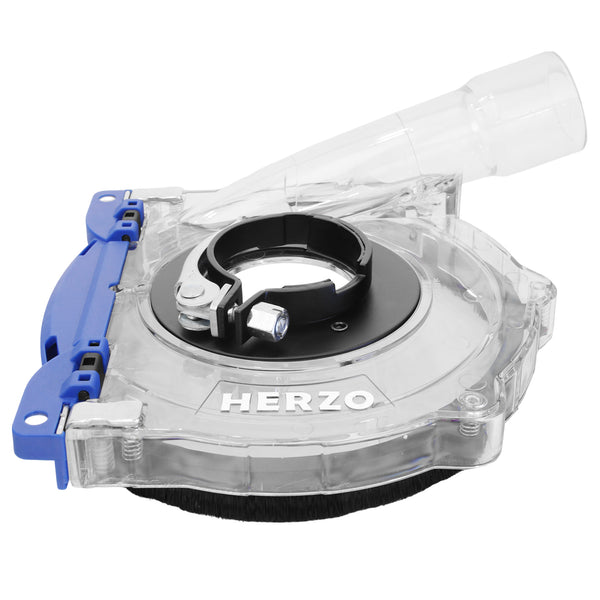
4. HERZO Transparent Grinding 125mm Dust Shroud
-
Best for: Operators who prioritize visibility while grinding—especially near edges, control joints, or when feathering transitions.
-
Why transparency helps: Being able to see the wheel-to-surface contact zone can reduce over-grinding and help you keep a consistent scratch pattern.
-
Diameter class: Built around the 125mm (5-inch) grinding workflow, which is common for remodeling and punch-list concrete fixes.
-
Dust-control goal: Keep dust inside the shroud path long enough for your extractor to pull it out—reducing airborne fines and cleanup.
-
When it’s most useful: Detail work: skim-coat removal, thinset cleanup, wall-adjacent grinding, and door-threshold transitions where accuracy matters.
-
Real-world trade-off: Transparent housings can show wear and dust film; keeping the viewing area clean helps preserve the visibility advantage.
Why it wins: Visibility is a performance feature. When you can see your grind line, you’re less likely to gouge, stall, or miss high spots—so you finish faster with fewer corrective passes.
5. HERZO Red Dust Shroud 180mm

-
Best for: 180mm grinding where you want a dedicated dust shroud option for larger grinders and bigger coverage passes.
-
Jobsite fit: Great when your schedule includes multiple open-area grinds and you need dust control to stay consistent across a long shift.
-
Dust containment focus: A larger wheel creates more debris volume; the shroud’s job is to keep suction concentrated so dust doesn’t escape at the edges.
-
Operational benefit: Reduced airborne dust can improve visibility in the work zone and reduce dust migration into adjacent finished areas.
-
What to check: Confirm hose fit to your extractor and ensure the shroud mounts securely to your grinder’s guard/collar system.
-
Trade-off: Like most 180mm setups, it may be less nimble for tight spaces—many pros keep a 125mm shroud as a second tool for corners.
Why it wins: If you already use a 180mm grinder for productivity, a properly matched shroud helps you keep that productivity without paying for it later in cleanup time and filter maintenance.
Buying Guide: How to Choose the Right Dust Shroud
Start with grinder size: 125mm vs 180mm
Do you need agility or coverage? A 125mm shroud is typically the choice for remodelers who work in tighter rooms, along walls, or around obstacles, because the tool is easier to steer and reposition. On the other hand, a 180mm shroud is built for larger grinders that can clear material faster over open areas. However, bigger wheels generate more debris volume, so your dust extractor and sealing quality matter more.
Match the shroud’s body material to your abuse level
If your grinder gets bumped on slab edges, columns, or stairs, a more rigid body (often aluminum) can help the shroud keep its shape and maintain a consistent seal. If visibility is a major issue—especially when you’re feathering or working near finished surfaces—a transparent housing can make the work more controllable. Either way, the “best” shroud is the one that stays aligned and sealed through the whole pass.
Think in systems: shroud + cup wheel + vacuum + technique
A dust shroud can’t do everything on its own. Diamond cup wheel style (turbo, segmented, etc.) changes dust generation and airflow behavior at the rim, and technique affects whether the skirt edge stays sealed. Keeping the shroud close to the surface, avoiding lifting the leading edge, and letting suction pull continuously will usually outperform a “better shroud” used with inconsistent technique.
Don’t ignore airflow and filter management
Many dust complaints are actually vacuum problems: clogged filters, leaky hoses, or undersized extraction for the wheel diameter. In late-2025 jobsite discussions, more teams are pairing grinding with higher-performing dust extractors and better filter practices to reduce silica exposure risk and avoid rework caused by dust-loaded grinding. For background on respirable crystalline silica concerns and why control measures matter on construction sites, see OSHA’s silica resources.
Choose visibility when precision matters
If you often ask, “Am I actually hitting the high spot?” then visibility is productivity. Transparent shrouds can help you track your grind pattern, reduce gouges, and keep a consistent finish when you’re working around edges. This is especially helpful on small patch jobs where you can’t hide mistakes under thicker floor systems.
Quick Comparison Table
|
HERZO option |
Grinder size class |
Best for |
Key advantage |
Trade-offs to consider |
|---|---|---|---|---|
|
125mm Aluminum Dust Shroud Kit + Diamond Turbo Cup Wheel |
125mm |
All-around concrete grinding + dust control in one package |
Simplifies setup; sturdy feel |
Less coverage than 180mm for big floors |
|
Aluminum Dust Shroud 180mm |
180mm |
High-volume slab prep |
Faster coverage potential |
Bulkier; needs strong vacuum airflow |
|
Transparent Grinding 125mm Dust Shroud |
125mm |
Precision grinding near edges/finished zones |
Better visibility at contact area |
Needs cleaning to keep viewing area clear |
|
Red Dust Shroud 180mm |
180mm |
Dedicated large-grinder dust control |
Consistent large-area workflow |
Less nimble in tight spaces |
|
HERZO Dust Shroud Kit (Clear) |
125mm |
Expanding multi-tool dust control |
Extra shroud capacity for crews |
Must verify exact fitment/mounting |
FAQ
Choose 125mm if you work in smaller rooms, do frequent edge work, or need better maneuverability around obstacles. Go 180mm when you’re grinding larger open areas and want to cover more square footage per pass. Also consider your vacuum capacity: 180mm setups generally generate more dust volume and need stronger airflow to keep capture consistent.
The most common causes are air leaks (loose collar fit, gaps at the skirt) or a vacuum system that isn’t pulling enough airflow due to clogged filters or hose leaks. Check that the shroud sits flat and stays close to the surface through the entire pass—lifting the leading edge even slightly can create a dust “escape path.”
You can use a transparent shroud for real grinding work, especially when visibility helps you control the cut and avoid gouging. The key is maintaining a stable seal and using a technique that keeps the housing from being slammed into edges or corners repeatedly. If your job is rough demolition-style grinding with lots of impacts, a more rigid shroud body may hold alignment better.
Start by ensuring the hose cuff fits snugly on the shroud’s dust port—loose connections reduce suction and can vibrate off mid-job. Keep the hose supported so it doesn’t pull the shroud sideways as you move; that sideways load can break the seal at the skirt.
A tight seal plus strong suction can increase drag, especially on flatter surfaces. Try adjusting your technique: keep steady forward motion, avoid pressing down excessively, and let the diamond cup wheel do the cutting. If your vacuum suction is adjustable, dialing it slightly down can reduce stickiness while still keeping capture effective.
Even short grinding tasks can create a lot of fine airborne dust. Beyond cleanliness, controlling dust helps maintain visibility and can reduce the chance of dust loading your abrasive. Many crews find that “quick” unshrouded grinds often take longer overall because of cleanup and rework. For additional context on why source capture matters, NIOSH resources on construction dust controls are a useful reference.
Conclusion
Choosing the right grinding dust shroud for your tools comes down to fitment, airflow, and how you actually grind on real jobsites. If you want maneuverability and control, a 125mm shroud—especially a transparent option for visibility—can be the most practical daily driver. If you’re covering bigger floor areas, stepping up to 180mm shrouds helps productivity, as long as your vacuum setup and sealing remain strong.
HERZO’s lineup shown here emphasizes durability, reliability, and dust-control-first design learned from field conditions. Pick the size that matches your grinder, prioritize a stable seal, and treat the shroud as part of a complete system with your cup wheel and extractor for the cleanest, fastest grinding workflow.


